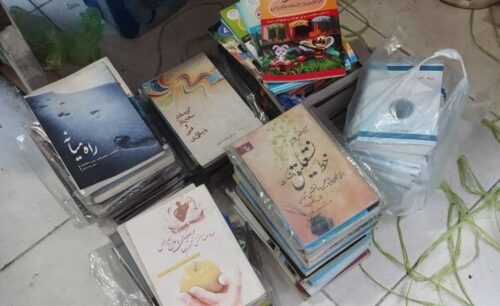
We are deeply grateful to acknowledge and thank our donor for their generous contribution to the Zebak Community Library. Through their support, the library has expanded its collection by 100 new titles, a milestone that may sound modest on paper but carries an outsized meaning in a region where access to books and learning materials has long been out of reach for most residents.
Every new title represents a question that can now be answered, a story that can now be told, a skill that can now be learned. For the children, youth, and adults who walk through the doors of the Zebak library, these new editions to their collection is a genuine broadening of the possible.
The Zebak library does not serve Zebak alone. Residents from surrounding villages and communities travel to access its resources, making it a true regional hub for learning — one of the very few of its kind in this part of Badakhshan. When we invest in this library, we invest in an entire network of communities for whom other educational infrastructure simply does not exist.
To our donor: your contribution will be felt far beyond the walls of a single building. Thank you.
The Stakes: Literacy in Rural Afghanistan in 2026
To understand why a community library matters so profoundly, it helps to look honestly at the educational landscape in rural Afghanistan today.
Afghanistan’s national adult literacy rate stands at approximately 37%, one of the lowest in the world, according to data from UNICEF and UNESCO. That figure is already sobering. But the national average masks a far more difficult reality in rural areas, where literacy rates fall dramatically lower, and particularly for women and girls. In some rural communities, female literacy has historically hovered near or below 10%. A 2022 analysis found that more than 90% of Afghan 10-year-olds are unable to read even a simple text, a figure that reflects years of compounding crisis layered on top of chronic underinvestment.
The causes are well-documented: extreme poverty, a shortage of trained teachers, inadequate infrastructure, long distances between communities and the nearest school, and since 2021 the formal ban on secondary and tertiary education for girls and women. UNICEF and UNESCO reported in late 2025 that more than 2.1 million primary school-aged children remain out of school in Afghanistan as of 2024. The country’s education system is, in their words, at a “critical crossroads.”
In rural Badakhshan, a remote, mountainous region with limited road access and scarce public services, these challenges are compounded further by geography. Schools are few. Qualified teachers are fewer. Government resources are thin to nonexistent.
Community Libraries Are The Infrastructure
In the face of these conditions, community libraries like the one in Zebak play a role that goes well beyond what their modest size might suggest.
Where formal schooling is unavailable, inconsistent, or has been taken away entirely, a community library becomes one of the only reliable spaces for self-directed learning. It is a place where a young man can continue developing skills that his school could not fully provide. It is a place where a mother can access health information that helps her family. It is a place where a girl can still find a book and keep reading.
Libraries also serve a community function that is harder to quantify but no less real: they signal that learning is a communal endeavour, and that a community’s future is worth investing in. In regions where outside institutions have often failed or abandoned the people they were meant to serve, a locally supported library is a statement of self-determination.
The Zebak library exemplifies this. It exists not because a government program mandated it, but because a community believed its residents deserved access to knowledge and because people far away, like our generous donor, agreed.
Looking Ahead: 500 Books in 2026
Expanding the Zebak library’s collection by 100 titles is a meaningful step and it has given us the confidence to aim higher. In 2026, our goal is to add 500 new titles to the Zebak Community Library. That would be a transformational leap for a collection serving not just one community, but an entire network of villages across the surrounding region.
We believe we can get there together. And we have a simple, powerful way for our community to make it happen.
Introducing: Buck a Book
The idea is exactly what it sounds like. For $1, you can put a book on the shelf of the Zebak Community Library.
One dollar. One book. One more door opened for a child in rural Badakhshan who has almost nothing else.
Our Buck a Book donor program is our invitation to our community to rally around this goal in 2026. Five hundred people giving a dollar each gets us there. So does a small business dedicating $500 as part of their community giving. Or a group of colleagues pooling together at lunch. The math is simple, and the impact is anything but small.
Every donation, at any level, goes directly toward purchasing new titles for the library. We are asking our donors, our partners, and anyone who believes that a child in Afghanistan deserves access to a book to join us this year.
Here is what 500 books could mean for Zebak and its surrounding communities:
- Young readers gaining access to stories, science, history, and ideas they have never encountered before.
- Women and girls finding a space where learning remains possible.
- Community members of all ages building skills, nurturing curiosity, and staying connected to the wider world.
Business for Better Society remains committed to this work for the long haul. The Zebak Community Library is an institution that grows with the community it serves. And with your support through Buck a Book, 2026 can be the year its shelves truly come alive.
Ready to put a book on the shelf? Click here to donate and spread the joy of reading.