 Before a documentary finds its audience at festivals or public screenings, there is often one audience that matters more than any other: the people whose lives are at the heart of the story.
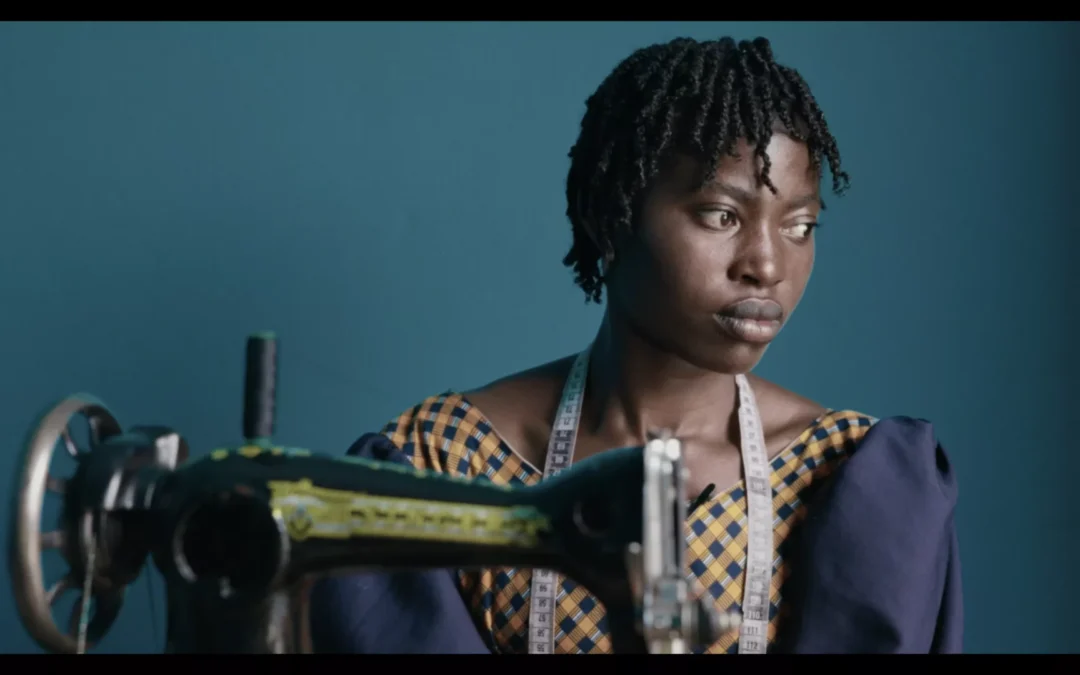
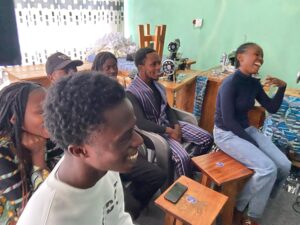
Recently, the six apprentices from our Threads of Transformation advanced tailoring program gathered to watch a rough cut of NDEGE, a documentary filmed in Goma, Democratic Republic of Congo. For Alliance, Jacques, Micheline, Sage, Delice, and Jospin, this was far more than an early screening. It was the first opportunity to see their own experiences, challenges, and hopes reflected on screen.
NDEGE is unlike a traditional documentary. While director Vitoria de Mello Franco and cinematographers guided the production, the apprentices also became filmmakers themselves, carrying cameras for months to document their daily lives, tailoring workshops, neighbourhoods, and the realities of living through conflict and displacement. The result is a film shaped not only by observation, but by the perspectives of those living the story.
Following the screening, the apprentices were asked a series of questions: How did it feel to watch the film? What has changed in your life? Who should see it? If you had the camera again, what story would you tell? And what was it like being part of the filmmaking process?
Their reflections were thoughtful, candid, and often deeply moving.
Watching their own story
Nearly every apprentice described an emotional experience.
Jacques said the film renewed hope within the group at a time when they had begun to lose heart in their training. Delice said watching the documentary filled her with joy and fresh motivation to keep moving forward. Sage described the experience as reliving an important chapter of their own history.
Alliance and Micheline both spoke about gratitude—gratitude for the opportunity to participate in the project and for the support they have received throughout their journey.
For all six apprentices, the screening was a reminder not only of what they had endured, but also of how far they had come.
Looking back and looking forward
The conversation naturally turned to how life has changed.
Several apprentices contrasted life before the war with the uncertainty that followed.
Jacques reflected that work and daily routines had once felt predictable, whereas today many families struggle simply to find enough food or earn enough money to get by. Micheline remembered when her tailoring business had a steady stream of customers before conflict disrupted everyday life. Delice spoke openly about the fear she experienced while watching young people join armed groups or lose their lives, and the constant worry for her family’s safety.
Yet none of them chose to end their story there.
Each spoke about hope. Delice noted that life has become calmer, while Sage and Jospin both described feeling more confident about the future than they did only a short time ago.
A film they want the world to see
When asked who should watch NDEGE, every apprentice answered with the same underlying message: as many people as possible.
Sage believes the film should reach young people, community leaders, and organisations. Jacques hopes audiences will better understand what communities in eastern DRC, and especially Goma, continue to experience. Micheline hopes the documentary reaches people who are in a position to help. Jospin simply wants people who know little about their circumstances to finally understand their reality.
Their responses reflected one common belief: stories can build understanding, and understanding can inspire action.
If the cameras kept rolling
One question looked toward the future rather than the past.
If they could continue filming, what stories would they tell?
Interestingly, most of the apprentices wanted to document progress rather than hardship.
Jacques would highlight young women pursuing careers in tailoring and fashion. Sage would capture both the ongoing challenges and the gradual rebuilding taking place in everyday life. Delice would focus on the resilience and determination of young people despite everything they have experienced. Jospin also spoke about documenting the small but meaningful signs of progress within the community.
Even after living through conflict, their instinct was not simply to record suffering, but to record hope.
Feedback from the people who know the story best
Because this was an early cut of the documentary, the screening also provided an opportunity for honest feedback.
Jacques suggested using music and sound to strengthen moments of emotion and adding narration to provide additional context for viewers unfamiliar with the region. Sage and Jospin felt there was room to include even more perspectives and detail while emphasizing that the documentary faithfully represents their experiences.
Perhaps Jacques’ most important observation was also the simplest.
He hopes the film leads to real change for the people whose stories it tells and not simply becoming another documentary that audiences watch and then forget.
That aspiration closely reflects why Business for Better Society undertakes projects like NDEGE: storytelling is most powerful when it contributes to lasting awareness, meaningful partnerships, and tangible opportunities for the communities involved.
Behind the camera
The apprentices also reflected on what it was like becoming filmmakers themselves.
Jacques laughed as he recalled that carrying a camera around Goma sometimes attracted suspicion, with people wondering whether they were spies. He said the support and personalities of the film crew helped make the experience enjoyable. Thomas often brought humour to the long days of filming, while Dan remained focused on capturing the story.
Sage and Jospin said the filming process became a natural part of daily life, even with the responsibility of transporting equipment between home and work. Micheline fondly remembered the crew spending time in each tailoring workshop and sharing meals together.
Those relationships helped transform the project from a film production into a genuine collaboration.
What comes next
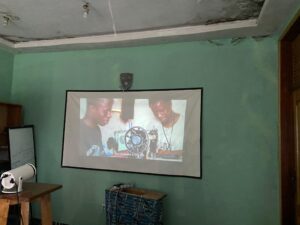
Although this screening marked an important milestone, it is only the beginning of NDEGE’s journey.
Director Vitoria de Mello Franco is now using NDEGE as a proof of concept for a feature-length documentary that will delve more deeply into the history of fashion in Congo, weaving that story together with the country’s broader history and the personal journeys of the six apprentices featured in the film.
Central to that vision is maintaining the collaboration with Alliance, Jacques, Micheline, Sage, Delice, and Jospin. Their voices have shaped NDEGE from the beginning, and they will continue to shape where the project goes next.
As we watched the apprentices watch their own stories unfold on screen, one thing became clear: NDEGE is more than a documentary. It is a collaboration, a record of resilience, and an invitation for audiences around the world to better understand the lives, talents, and aspirations of six remarkable young people whose story is only just beginning.